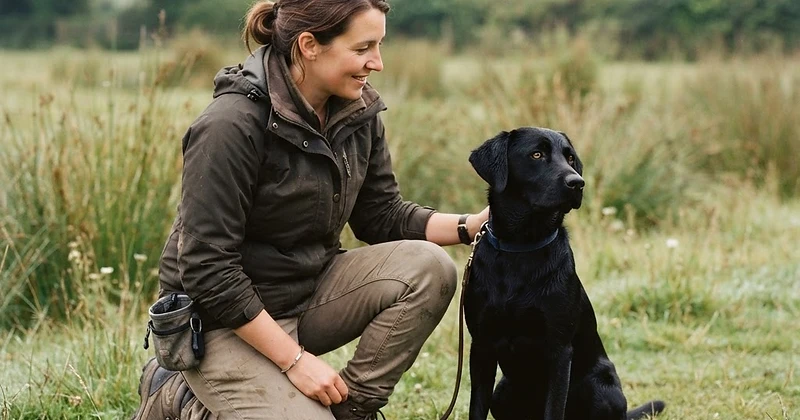
A trainer working with a Labrador in a sit-stay on a grassy field

WagLine · Training

A conversation, not a command.

The foundational method WagLine returns to across every breed — built on timing, consistency, and reward.

The Method

Master the basics. The rest is variation.

Training is a conversation, not a command. The dogs that thrive are the ones whose handlers learned to listen first. What follows is the foundational method WagLine returns to across every breed — built on timing, consistency, and reward. Master the basics and the rest is variation.

Four Pillars

Where every dog starts

01

Foundations

The relationship is the real curriculum. Before any command, a dog has to trust that you're clear, fair, and worth listening to.

  • Keep sessions short — five to ten minutes, two or three times a day. Dogs learn in reps, not marathons.
  • Reward within one to two seconds of the behavior. Late rewards reward the wrong moment.
  • Teach one thing at a time. Stacking commands builds confusion, not fluency.
  • Always end on a success. Set the last rep up to be easy and clean.
02

Leash & Recall

A loose leash and a reliable recall are the two skills that buy a dog a life. Everything else is built on them.

  • Reward position, not correction. Pay the dog for walking at your side rather than jerking for pulling.
  • Practice recall on a long line before you ever trust it off-leash. Freedom is earned in stages.
  • Never punish a dog that comes to you — even late. The recall must always be the safest place to land.
  • Use a consistent marker (a word or a click) the instant the dog turns toward you.
03

Socialization

Socialization is not exposure; it's good exposure. The goal is a dog who is curious, not overwhelmed.

  • Let the dog set the pace. Approaching new people, dogs, and surfaces should be the dog's idea.
  • Pair every new experience with something the dog values. Novelty earns its good association.
  • Quality over quantity. A few calm, positive encounters beat a dozen chaotic ones.
  • Watch for the threshold — the point where curiosity tips to stress. Stop one step before it.
04

Advanced & Sport

Once the foundations hold, give the dog a job. Working and sporting breeds especially need a problem that's theirs to solve.

  • Channel instinct, don't suppress it. A retriever fetches; a herder gathers; a terrier hunts. Give the drive an outlet.
  • Raise criteria in small steps. The dog should win roughly 80% of the time to stay engaged.
  • Train for the environment you'll work in. Distractions are a skill, added gradually.
  • Keep it fun for the handler, too. The dog reads your energy long before the cue.

The Toolkit

Foundational methods

Positive Reinforcement

Reward the behavior you want so it happens more often. The most studied, most reliable method across every breed and every age.

Marker Training

A consistent signal — a word or a click — marks the exact moment the dog does the right thing, then a reward follows. It builds clarity and speed.

Capturing

Wait for the dog to offer a behavior on their own, then mark and reward it. Teaches the dog that their choices matter and that offering is safe.

Shaping

Reward small steps toward a goal, raising the bar gradually. Builds complex behaviors from simple ones without force or frustration.

Field Notes

Quick tips that hold

  • 01Train before meals, not after — a slightly hungry dog learns faster.
  • 02Let the dog rest after a session. Sleep is when learning consolidates.
  • 03If you're frustrated, end the session. Emotion travels down the leash.
  • 04Keep a log of what you trained and what stuck. Progress is invisible day to day.
  • 05Reinforce the calm you want, not just the commands. A settled dog is a trained dog.
Train the dog in front of you.

Every breed was shaped by a purpose. Train to it.